
Educational Guides·6 min read
What Are Peptides?
Short chains of amino acids that act as precise biological signals — a primer grounded in the peer-reviewed literature.
July 1, 2026
— Resources
Research, guidance, tools, and transparency—all in one place.
— Journal
Every article summarizes primary literature from PubMed, Nature, Cell, The Lancet, NEJM, JAMA, and the NIH — cited in full and linked to the original source. Educational content only; no treatment claims.
Short chains of amino acids that act as precise biological signals — a primer grounded in the peer-reviewed literature.

From receptor binding to second-messenger cascades: the molecular grammar peptides use to instruct cellular behavior.

GHRH analogs and ghrelin-receptor agonists modulate endogenous pulsatile GH release — a look at the underlying pharmacology.

Angiogenesis, cell migration, and extracellular matrix remodeling — how repair peptides are studied in preclinical models.

Incretin biology, amylin analogs, and the pharmacology behind a decade of metabolic peptide breakthroughs.

Endogenous and synthetic peptides studied for effects on neuronal survival, plasticity, and stress resilience.

From the isolation of insulin in 1921 to modern engineered analogs — a century of peptide therapeutics.
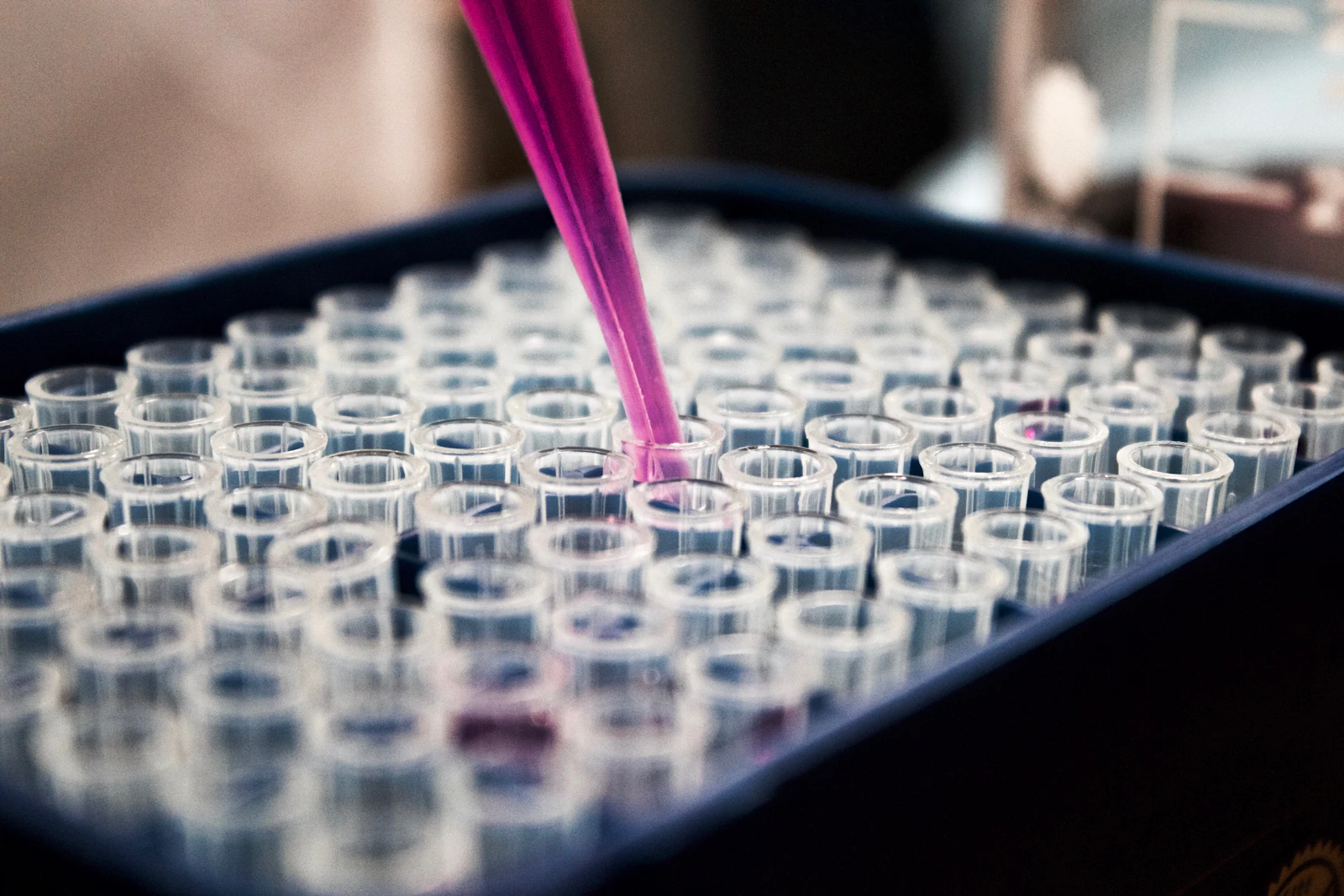
Temperature, pH, oxidation, and aggregation — the physical realities that govern peptide integrity in the laboratory.

Why freeze-drying is the preferred format for peptide preservation — the physics of sublimation in plain English.

Diluent selection, technique, and the arithmetic behind returning a lyophilized peptide to solution.

mg, mcg, IU, and mL — a short reference for interpreting the numbers on a research protocol.

Phase 1 through phase 4 — the framework used to establish safety, efficacy, and real-world performance.

Handling, documentation, and the institutional frameworks that safeguard research integrity.
— Reference Guide
Vial size, reconstitution, dosage, cadence, and cycle architecture across the full THRVE catalog. Send any peptide directly to the Research Calculator.
Metabolic
NNMT inhibitor — metabolic flexibility
Metabolic
Lipolytic GH fragment 176-191
Recovery
Systemic tissue & gut repair
Metabolic
Amylin pathway research
Performance
GHRH analog — extended GH window
Cognitive
Delta-sleep induction & HPA quieting
Longevity
Pineal peptide — telomere & circadian
Recovery
Blended repair research — systemic + connective tissue
Beauty
Copper peptide — skin regeneration & collagen research
Beauty
Beauty blend — radiance & density
Metabolic
Triple receptor research compound
Beauty
Master antioxidant — clarity & detox
Performance
Long-acting growth-factor analog — signaling research
Performance
Blended GHRH + GHRP research — synergistic GH pulse
Performance
Selective GHRP — clean GH pulse
Hormonal
HPG axis upstream — endogenous T
Recovery
Anti-inflammatory tripeptide
Hormonal
Melanocortin analog — libido & pigmentation research
Longevity
Mitochondrial peptide — metabolic flex
Longevity
Cellular energy & DNA repair
Longevity
Neuroprotection & cognitive longevity
Hormonal
Bremelanotide — libido on-demand
Cognitive
Cognitive neuropeptide — calm focus, stress modulation research
Metabolic
GLP-1 receptor analog — composition
Cognitive
Neuropeptide research — BDNF, focus, and memory pathways
Beauty
Cosmetic peptide research — expression lines, skin appearance, collagen studies
Recovery
Connective tissue regeneration
Performance
GHRH analog research compound
Metabolic
GIP/GLP-1 dual-receptor research
— Research Calculator
Units to draw, mg per unit, and total servings on a U-100 insulin syringe. For research reference only.
≈ 250 mcg
BPC-157
Draw to deliver 0.25 mg
10.0units
≈ 0.100 mL · on a U-100 insulin syringe
U-100 Syringe · Reference
10.0 / 100 units
mg / mL
2.50
Dose mL
0.100
Servings
20
Refrigerate reconstituted vial at 2–8°C. Use within 28 days.
— Frequently Asked Questions
— Affiliate Program
Share the science. Earn with purpose. We partner with a considered group of practitioners, clinicians, and creators who share our standards.